Wednesday, September 24, 2025

Geog 12: Glaciation Review sheet

 Test/Large quiz is on Friday.  

Earth Matters Text book pages:  102-103, 132-139

There will be two diagrams to label.  There will be some short answer questions.  There may be a T/F section where you have to back up your answer.

Understand the terminology and how to apply it.

Understand how glaciation is an agent of gradation.

Be able to describe why a crevasse forms.

Be able to differentiate between erosional and depositional landforms.

Know the following terminology:

Glaciation:

U & V shaped valley

Glacier

Hanging glacier/valley

Moraine (terminal, lateral etc)

Isostasy              drumlins

Abrasion             erratics

Finger lakes    outwash plane

Drumlins             esker

Kames               icefall

Kettles               cirque

Arete                  col

Horn                   skerries

Alpine glaciation

Continental glaciation

Gradation
Fjord

Geog. 12 Sept. 23 - River Systems

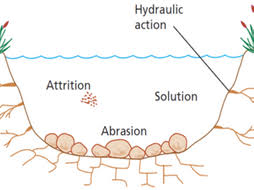
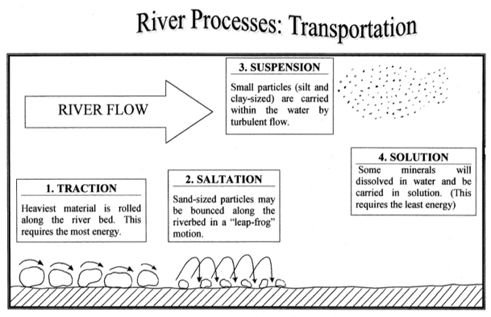
 Today in Geog 12 we reviewed the glaciation sheet and added some definitions to the diagram on the third page from Earth Matters text book p. 134.  We then turned our attention back to river systems (specifically erosion and transportation)and took some notes and did some reading in Earth Matters to reinforce our learning from our notes.  We read pp. 116-118 (up to Underground River Landscapes) to also help our understanding.

Here are a couple of diagrams to help you out with the processes:


We watched this video to help our understanding:  https://www.youtube.com/watch?v=8EIoBao-UvI


Monday, September 22, 2025

Sept. 22 Geog & SS

 Socials 10:

Today we started our new unit on Canadian Identity.  We did a major brainstorm on Canadian identity and what it means to be Canadian in small groups creating mind maps.  From here we did some comparing of each others mind maps pulling out similarities and great ideas and then each student created their own mind map on Canadian identity pulling from the ideas around the room.  We then compared these to our identity maps from earlier in the year.  We came to some conclusions around Canadian identity and what influences identity including our vast geography.  The idea that people in different parts of the country identify with different things, bringing our discussion to regionalism.  We also discussed Canadian identity also being not American and how this affects us both historically and now.

Tuesday we will be working on our role play on government.

Geography 12

Students got field trip forms for our planned field trip to Rogers Pass.  If you were away please come and pick one up.

We went over our Friday 5's.  From here we reviewed some glacial depositional features:  kames, eskers and drumlins.  We discussed moulins and watched these two videos:  

https://www.youtube.com/watch?v=CVAPWfyoxK4

https://www.youtube.com/watch?v=OvRXWbTZ8YY

and did a review sheet on glaciation.  ***Small test on glaciation on Friday

Tuesday we will discuss river systems a bit more and have some connections model presentations.  We will also look at a topographic map of Rogers pass and where we are going on Thursday.


Saturday, September 20, 2025

Answers to Friday 5: Sept. 19

 1. Define gradation.

Gradation refers to the processes that lead to the gradual leveling or smoothing of the Earth's surface over time through natural forces. It encompasses the mechanisms by which landforms are eroded, transported, and deposited, contributing to the overall shaping of the landscape.

2. What are the three key concepts associated with gradation?

Erosion, Transport, Deposition

3. What are some similarities or differences between alpine and continental glaciers?

Differences:

Location; Alpine glaciers are only found on mountain tops where as continental glaciers are only found at the earth's poles regardless of elevation. Size; Alpine glaciers are smaller compared to Continental glaciers.

Similarities:

Both move and cause erosion. Both change the landscape. Both developed in constantly cold temperatures below freezing.

4. Define cirque.

A cirque is a steep sided hollow or amphi-theater type depression that is the result of glacial erosion at the head of an alpine valley.

5. What are two glacial features formed by either erosion or deposition?

erosion - cirque, arete, horn, tarn, v,u shaped vallies

deposition - moraine, erratic (kame, esker but we haven't talked about this yet)

Sept. 18 & 19th SS & Geog

 Thursday

Socials 10:

We finished up the government unit, did a bunch of review, including a review sheet.  Students also read an article comparing the american and canadian systems of government and used a venn diagram to compare these.  We played a review kahoot and submitted Senate questions.  All in preparation for our test on Friday.

Geography 12:

We were out in the field all day collecting data at Bridge creek.


Friday:

Socials 10:  

Test on Government and then if done students worked on their role play assignment.

Geog. 12

Friday 5, finished up glaciation notes (TEST coming up on glaciation this coming week) and then students went on the Terry Fox run/walk


Wednesday, September 17, 2025

Socials 10 & Geog 12 Sept 15/16

 Geog. 12

Monday - we went over Friday 5, spent time working on either the glaciation review sheet or connections model work.  I did some review using some photos particularly talking about striations and moraines. 

Tuesday we continued working on our glaciation sheets, we started to go over them as we reviewed some ideas and vocab.  We did some notes and are in the process of finishing up glaciation.  Please find the slides and videos below.

https://www.youtube.com/watch?v=wbsURVgoRD0

https://www.youtube.com/watch?v=loI584OFVpE

https://www.youtube.com/watch?v=mspVqx3vgek

https://www.youtube.com/watch?v=CVAPWfyoxK4


Social Studies 10

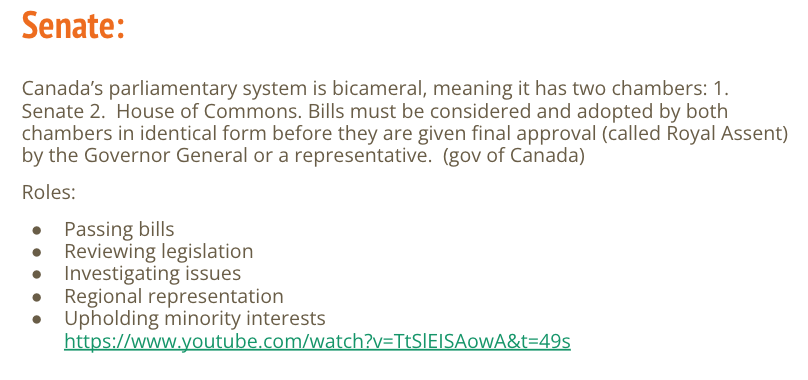
Monday - we went over the Friday 5.  Then we talked about the branches of government and I taught on the Senate.  See slides below and the video links.

Tuesday - we talked about the law making process, made a diagrammed set of notes on how a bill becomes a law, watched a couple of videos on this and worked on completing Senate Questions. We finished off assigning roles for the simulation and got both the bill and a hand out on our role.  Reminder that there is a test on Friday and the review sheet is on the blog.

https://www.youtube.com/watch?v=4O8syj77goQ&t=1s


Socials 10: Government review sheet. (Assessment #1)

Socials 10:  Government Review sheet


Terminology:
Political spectrum:  Right, Centre and Left wing government ideologies
Communism, Fascism, Capitalism, Liberalism, Socialism, Conservatism, etc...
Levels of Govmt:  municipal, provincial, federal
Branches of Govmt:  Executive, Legislative, Judicial
Governor General
Lieutenant Governor
Prime Minister
Premier
Mayor
Cabinet, Cabinet post/portfolio, Cabinet solidarity, shadow cabinet
Senate (Upper House)
Caucus
patronage
House of Commons (lower house)
Constitutional Monarchy
Direct vrs Representative Democracy
majority vrs minority government
Republic
First past the post vrs proportional representation 
Free Vote
Referendum
Speaker of the House
Private Members Bill
Pluralism
Diversity


Some questions:
Be able to describe the different parts of the political spectrum and put the different ideologies on as well as our current political parties (Liberal, Conservative, NDP & Green, BQ).  Be able to hypothetically apply the different ideologies.
Be able to describe our electoral system.
Understand and explain the different branches of government
Senate and the issues around it.
Federal vrs Provincial responsibilities.
Different ways you as a citizen can influence government 
Informed citizenship
Differentiate between the American and Canadian systems of government (if we get there)
Be able to take a bill to a law.
Understand the major positions of government (GG, PM, Cabinet, MP etc...)
Majority government vs. Minority government
Understand voting & election
Be able to differentiate between the American and Canadian political systems